

Cloud Gaming: The Future of Mobile Games
October 2, 2026
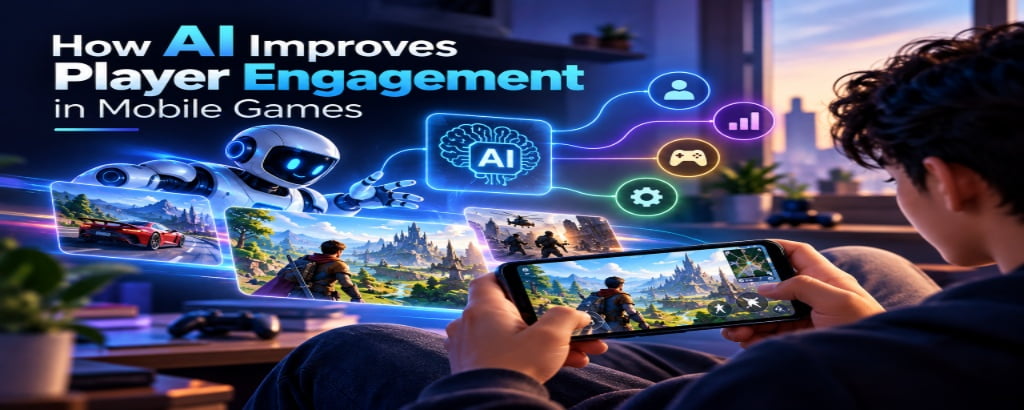
Have you ever wondered why some mobile games keep you playing for hours while others lose your interest within minutes? The secret often lies in how the game understands its players, responds to their actions, and creates exciting experiences. Today, Artificial Intelligence (AI) is helping developers make games smarter, more interactive, and more enjoyable than ever before.
In 2026, AI is becoming an important part of the gaming industry. From intelligent characters to personalized challenges, developers are using modern technology to understand player behavior and improve the overall gaming experience. Whether you enjoy racing games, action adventures, puzzles, or multiplayer experiences, AI is changing how games respond to you. Let’s explore how AI improves player engagement in mobile games and why it matters for the future of gaming.
What Is AI in Game Development?
AI in game development refers to the use of artificial intelligence to make games more responsive, adaptive, and efficient. It can help characters make smarter decisions, adjust difficulty levels, analyze gameplay patterns, and support developers during testing.
Earlier games often relied on fixed rules and predictable character behavior. Modern AI techniques can make gameplay feel more dynamic by responding to what players do. For example, an enemy might change its strategy when a player becomes more skilled, or a game might suggest a challenge based on previous performance.
AI does not automatically make every game better, but when used thoughtfully, it can help developers create experiences that feel more personal and rewarding.
Personalized Gameplay Keeps Players Interested
Every player has different preferences. Some enjoy difficult challenges, while others prefer relaxed gameplay and steady progress. Offering the same experience to everyone can make a game feel too easy for some players and too difficult for others.
AI can help developers analyze gameplay patterns and adjust certain elements to suit different skill levels. A beginner might receive helpful guidance, while an experienced player could face more challenging obstacles.
This personalization can make players feel more comfortable as they learn and more motivated as they improve. Instead of creating a one-size-fits-all experience, developers can design games that adapt to different playing styles.
Smarter Characters Make Games More Exciting
Characters controlled by the game, commonly known as non-player characters (NPCs), play an important role in creating engaging gameplay. When these characters behave predictably, players may quickly learn their patterns and lose interest.
AI can help NPCs respond more intelligently to player actions. Enemies might use different tactics, teammates could react more effectively, and characters might respond differently depending on the situation.
Imagine playing an action game where enemies adapt to your strategy instead of repeating the same movements every time. These interactions can make each session feel more challenging and unpredictable, giving players a stronger reason to keep playing.
AI Makes Challenges More Rewarding
A good game needs the right balance between difficulty and enjoyment. If a game is too easy, players may become bored. If it is too difficult, they may become frustrated and stop playing.
AI can help developers understand where players struggle and identify levels that may need adjustment. Based on gameplay data, developers can improve enemy behavior, refine level design, and create a more balanced progression system.
For example, a puzzle game could introduce more complex challenges as players improve, while an adventure game could provide optional hints when someone becomes stuck.
The goal is not to remove every challenge. It is to make challenges feel fair, achievable, and satisfying.
AI Helps Developers Understand Player Behavior
One of the most valuable benefits of AI is its ability to help developers analyze large amounts of gameplay data. This information can reveal which features players enjoy, where they stop playing, and which parts of the game need improvement.
Developers can use these insights to make informed decisions about future updates. If players frequently leave a particular level, the team can investigate whether it is too difficult, confusing, or repetitive.
This approach allows studios to improve their games based on actual player behavior rather than relying entirely on assumptions. It also helps developers prioritize changes that can make the biggest difference to the player experience.
Better Game Testing Creates Smoother Experiences
Nothing ruins an exciting gaming session faster than crashes, bugs, lag, or broken controls. Even a creative game concept can struggle if the technical experience is frustrating.
AI-assisted testing tools can help developers identify potential bugs, explore gameplay scenarios, and detect performance issues more efficiently. Developers can then investigate these problems and make improvements before releasing updates.
For mobile games, this is particularly important because players use different smartphones, operating systems, screen sizes, and hardware configurations. Better testing helps teams deliver more reliable gameplay and reduce the technical issues that can cause players to leave.
AI and Cloud Gaming: A Powerful Combination
Cloud gaming is changing how players access games by allowing supported titles to run on remote servers and stream gameplay to compatible devices. AI can complement this technology in several ways, including analyzing player behavior, supporting intelligent game systems, and helping developers optimize certain processes.
For example, AI-powered systems may help personalize experiences or analyze performance patterns across different sessions. However, smooth cloud gaming still depends on reliable internet connectivity, low latency, and suitable server infrastructure.
As these technologies develop, their combination could create more flexible and responsive gaming experiences for players across different devices.
Can AI Help Games Become More Popular?
AI can support player engagement, but it cannot guarantee that a game will become successful. A game still needs enjoyable gameplay, attractive design, reliable performance, and a clear identity.
When developers combine AI with thoughtful game design, they can create more personalized experiences and use player feedback more effectively. This may encourage users to return, explore new features, and recommend the game to others.
The most successful approach is to use AI to solve real problems and improve the player experience rather than adding technology simply because it is trending.
About SSN Games
At SSN Games, we believe that great gaming experiences come from combining creativity, innovation, and the right technology. We are SSN Games, and we are experts in developing games fast with high-tech technology. Our team focuses on creating engaging, scalable, and high-performance gaming experiences for startups, businesses, and entrepreneurs.
From game concept and UI/UX design to development, testing, optimization, and deployment, we work to transform creative ideas into exciting digital products. We explore modern development techniques, including AI-supported solutions where appropriate, to help build games that meet today’s player expectations.
Whether you are planning a mobile game, an interactive experience, or a multiplayer project, SSN Games can help bring your vision to life with a development approach focused on quality, performance, and innovation.
Final Thought
AI is changing how mobile games are designed, tested, and experienced. Personalized challenges, smarter characters, improved testing, and better player insights are helping developers create more engaging gaming experiences.
However, technology alone is not the secret to success. The real value of AI comes from using it to understand players, solve problems, and make gameplay more enjoyable.
As AI continues to evolve, developers will have new opportunities to build games that feel more responsive, intelligent, and immersive. For game studios, the opportunity is clear: combine human creativity with modern technology to create experiences that players genuinely enjoy and want to return to.