

How to Increase Downloads for Your Mobile Game
September 18, 2026
How AI Improves Player Engagement in Mobile Games
October 9, 2026
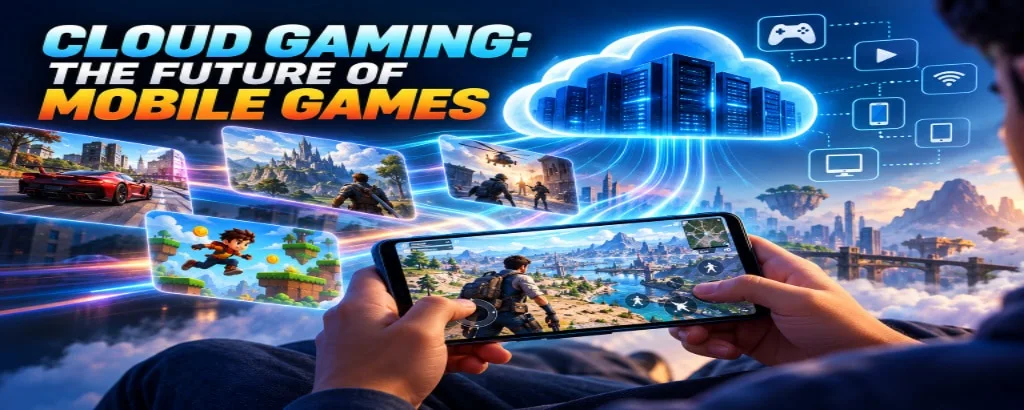
Imagine playing a high-end game on your smartphone without downloading a huge file, worrying about storage space, or buying an expensive gaming device. Sounds futuristic, right? Cloud gaming is making this experience increasingly possible by changing the way people access and play games.
Instead of running the entire game directly on a smartphone, cloud gaming uses powerful remote servers to process the game. The gameplay is then streamed to the player’s device through the internet. This means players can experience advanced graphics and demanding games even when their smartphones don’t have powerful hardware.
As internet connectivity improves and cloud technology becomes more advanced, cloud gaming could become an important part of the future of mobile gaming.
What Is Cloud Gaming?
Cloud gaming is a technology that allows users to play games without installing and processing the complete game on their own device. The game runs on a remote server, while the player’s smartphone receives the video and sends their controls back to the server.
Think of it like streaming a movie, but instead of simply watching, the player is actively controlling what happens on the screen. The server handles the complicated processing while the player’s device displays the result.
This approach can remove some of the traditional hardware limitations associated with mobile gaming and create new opportunities for developers and players.
Why Cloud Gaming Is Changing Mobile Gaming
Traditional mobile games need to be downloaded and installed on a smartphone. Large games can take up several gigabytes of storage and may require powerful processors and graphics hardware to run smoothly.
Cloud gaming changes this model. Because much of the processing happens remotely, players can potentially access more demanding experiences without needing the latest smartphone.
This could make advanced gaming more accessible to a wider audience. Instead of constantly upgrading their phones for better gaming performance, users may increasingly depend on reliable internet connections and cloud gaming platforms.
Better Games Without Huge Downloads
One of the biggest advantages of cloud gaming is reduced dependence on large game downloads. Players can potentially start a game through a streaming service without waiting for the complete game package to install.
This can be particularly useful for smartphone users with limited storage. It also makes trying new games easier because players may not need to commit significant storage space before experiencing the gameplay.
For developers and publishers, this creates another opportunity to increase download Mobile Games visibility and encourage users to try new gaming experiences through easier access and streaming-based platforms.
High-End Gaming on Mobile Devices
Mobile hardware has improved dramatically over the years, but smartphones still have limitations when compared with high-end gaming PCs and consoles.
Cloud gaming can help bridge this gap by moving demanding processing tasks to powerful servers. A smartphone doesn’t necessarily need to perform every complex calculation itself because the cloud infrastructure handles much of the workload.
This could allow players to experience visually impressive environments, advanced physics, large game worlds, and other demanding features on devices that might otherwise struggle to run them.
However, the quality of the experience still depends heavily on internet speed, latency, and network stability.
Faster Access Means Better Player Experiences
Players don’t like waiting. Long downloads, large updates, and installation requirements can become barriers between users and the games they want to play.
Cloud gaming has the potential to reduce some of these barriers. A player could discover a game, launch it through a cloud platform, and begin playing much faster.
This can also benefit game discovery. Players may be more willing to experiment with new titles when accessing them doesn’t require a large installation or long download.
For gaming companies, easier access could create new opportunities to attract players and introduce them to different gaming experiences.
The Importance of 5G and Better Internet
Cloud gaming depends heavily on connectivity. Unlike traditional games that can often continue working without an internet connection, cloud gaming requires continuous communication between the player’s device and the remote server.
This is where faster mobile networks and improved internet infrastructure become extremely important.
Technologies such as 5G can provide higher speeds and lower latency in supported environments, making real-time game streaming more practical. As connectivity continues improving, cloud gaming may become more reliable for mobile users.
However, network availability and quality can still vary significantly between locations, so developers and platforms need to consider different connection conditions.
Cloud Gaming and the Future of Game Development
Cloud gaming is not only changing how players access games; it can also influence how developers design them.
Developers may have more freedom to create larger and more technically advanced experiences without depending entirely on the hardware capabilities of every player’s smartphone. Cloud infrastructure can also support features that require significant processing power.
At the same time, developers need to think carefully about latency, server capacity, security, scalability, and network performance. Creating a cloud-based experience requires a different technical approach compared with developing a traditional standalone mobile game.
Can Cloud Gaming Replace Traditional Mobile Games?
Cloud gaming is exciting, but it is unlikely to completely replace traditional mobile games in the immediate future. Downloadable games still have important advantages, especially when players want offline access, lower latency, or greater control over their gaming experience.
Instead, both models can exist together. Some players may prefer lightweight downloadable games, while others may choose cloud gaming for larger and more demanding experiences.
The future of mobile gaming may therefore be a combination of traditional games, cloud streaming, hybrid experiences, and new technologies that haven’t become mainstream yet.
How Cloud Gaming Could Improve Player Engagement
Accessibility can have a major impact on engagement. If players can start a game quickly and experience high-quality gameplay without worrying about storage or hardware limitations, they may be more willing to explore new titles.
Cloud gaming can also make it easier for players to move between devices. Depending on the platform and service, players could potentially continue their gaming experience across smartphones, tablets, PCs, or other supported devices.
This flexibility could become increasingly valuable as gaming becomes more connected and personalized.
About SSN Games
At SSN Games, we believe the future of gaming will be shaped by creativity, innovation, and advanced technology. We are SSN Games, and we are experts in developing games fast with high-tech technology. Our team focuses on creating engaging, scalable, and high-performance gaming experiences for businesses, startups, and entrepreneurs.
From game concept and design to development, testing, optimization, and deployment, we focus on building games that deliver smooth experiences and meet modern player expectations. We continuously explore new technologies and development approaches to help transform creative ideas into exciting digital gaming products.
Whether you’re planning a mobile game, multiplayer experience, or a next-generation gaming concept, our goal is to help bring your vision to life with the right technology and development strategy.
The Future Is More Connected
Cloud gaming is changing the traditional idea of what a mobile game can be. Instead of depending entirely on the hardware inside a smartphone, players can increasingly access powerful gaming experiences through connected cloud infrastructure.
There are still challenges to overcome, particularly around internet reliability, latency, server costs, and accessibility. But as technology and connectivity continue to improve, cloud gaming has the potential to become an increasingly important part of the mobile gaming ecosystem.
The future of mobile gaming may not simply be about having a more powerful smartphone. It could be about having better access to powerful technology wherever you are. And with cloud gaming bringing advanced experiences closer to everyday players, the next generation of mobile games could be more immersive, accessible, and connected than ever before.